
 +38 (067) 965-77-57
  info@bud-komplex.com.ua


“Dry” lumber is not a luxury, but a guarantee of construction quality
Some construction companies, in order to reduce the cost of building frame houses, use boards and beams of natural moisture (that have not undergone a special drying procedure).
But do they explain to their customers the risks of such savings?
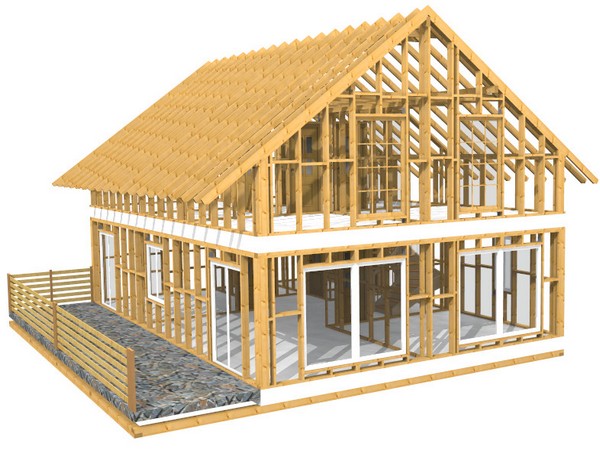
A “wet” board is prone to infection with fungus, mold, and other wood diseases, which leads to a reduction in the service life of wooden structures. A frame house built from lumber with natural moisture can rot in a few years. At the same time, you will not even know what is happening with the load-bearing structures of your house, because they are hidden behind finishing materials. No antiseptics will help here, because raw wood simply cannot absorb it.
Over time, the wet board begins to dry, which creates several problems at once. The humidity of the air inside the house increases, the formation of condensation and wetting of finishing materials is possible. There are significant geometric deformations of individual parts, and in completely different directions, even in two knocked-down boards. As a result, gaps and distortions appear in the structure, cold bridges are formed, and the finish is destroyed.
The strength of a raw board is lower than that of a dry one, and all the data in the handbooks on the strength of wooden structures are given specifically for the dry material. So the correspondence of the calculations when designing the real characteristics of structures made of raw wood raises questions.
We use only a planed board of chamber drying, humidity in the range of 14-18%, which is practically not prone to shrinkage and deformation. Heat treatment at temperatures over 70 ° C completely removes all types of fungus and other defects from wood. The gouge allows you to adhere to exact geometric dimensions, relieves the internal tension of the wood, makes it possible to defect the wood at the stage of purchase. Therefore, only materials with a permissible number of defects enter the structure.
Some unscrupulous builders try to assure their customers that the dry material will still get wet during the construction process due to rains and become wet again, but this is not the case. Only the upper layers of the dried board (up to 2 mm from the surface) can get wet from the rain, which dry out through natural ventilation after installing the roof, until the time of installation of the insulation in the frame of the house. But the board of natural humidity absorbs water almost like a sponge, and in case of rain during construction, it will collect even more moisture, which will then be released inside the houses




 Viber
Viber  Telegram
  WhatsApp
  E-mail